
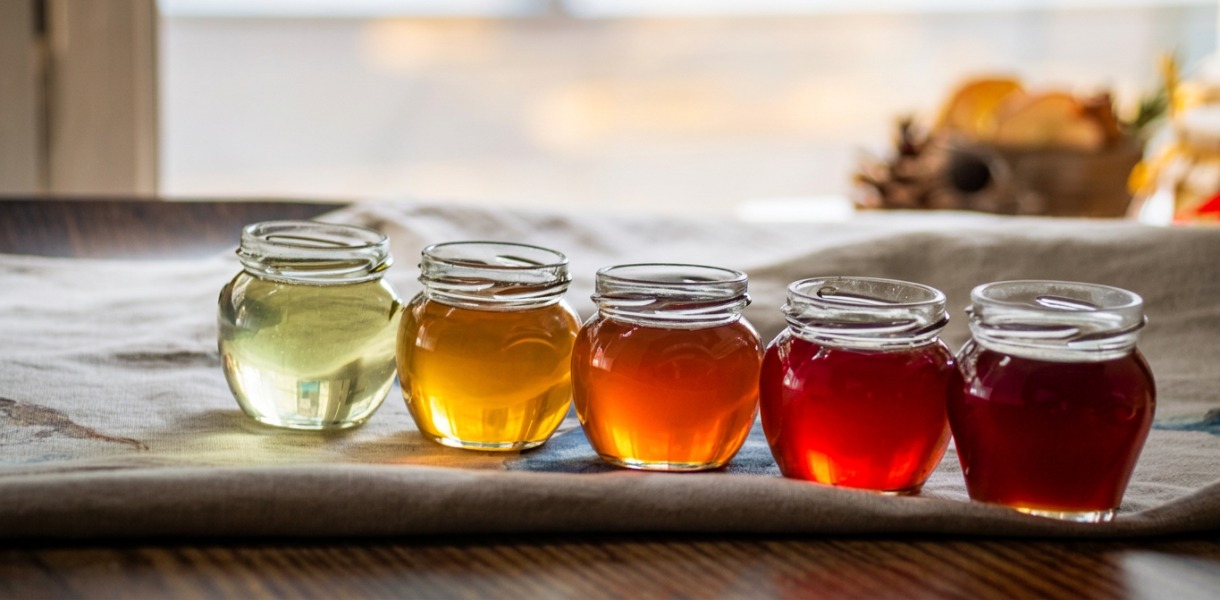
We hear this a lot: all honey tastes the same. People usually say it kindly, sometimes a bit apologetically, and often they’ve simply never had a reason to think about honey much. They’re not wrong, either. They’re just talking about one kind of honey rather than honey as a whole.
Most of the honey on a supermarket shelf is a blend, pooled from several countries and several harvests so that every jar tastes like the last. It’s usually heat-treated too, which keeps it clear and runny on the shelf for longer. None of that is a flaw. A blend is built for consistency, and something built to be consistent doesn’t leave you much to tell apart.
So “honey tastes the same” says very little about anyone’s palate. It’s a fair description of what that honey was made to do.
You can taste more than you think
Taste is less fixed than it feels. Give it something to compare and it sharpens quickly. In a 2025 study at Tohoku University, people got noticeably better at picking up sweetness after just three days of practice. Their taste buds stayed the same. The change is that their brain had more to measure against. Brain scans of sommeliers tell the same story. A wine expert’s tongue isn’t much different from a beginner’s, but their brain draws more on memory to make sense of what they’re tasting. Years of practice have given them a large mental library of flavours to sort each new one into.
Oxford researcher Charles Spence, who studies how we perceive flavour, describes it as something the brain builds from memory and expectation. That’s also why flavour can be learned at all, each honey you taste properly becomes a reference point for the next.
That’s also why flavour can be learned at all. Much of it is built in the brain from memory and expectation, so each honey you taste properly becomes a reference point for the next.
The catch: you need something worth comparing
This is where a honey made to taste identical every time runs into trouble. A palate can only build that library if what it’s tasting changes. Get through as many jars of the same blend as you like and there’s still nothing new to notice.
Blending does this on purpose. Honey from different regions and different years is combined and evened out until every jar matches, and the differences you might have learned from are gone before the lid goes on.

What single-origin honey gives back
Honey that hasn’t been blended still carries where it came from: the flowers in bloom that season, where the hives were and the weather that year. Two honeys gathered from different flowers a few weeks apart can taste further apart than most people would expect from the same product.
That’s the difference with our single origin honeys. Nothing has been blended out of it.
Try it yourself
All you need is two honeys and a bit of patience.
Next time you taste honey, hold off on deciding whether it’s “nice” and ask something more specific. Is it sweet, floral, earthy or sharp? That question does most of the work, and the more honeys you put side by side, the easier the differences are to spot.
A good place to start is our Scottish Blossom followed by the Heather. It’s the clearest contrast we sell: mellow and light first, then sharp and almost resinous straight after. If you can’t get into the shop on Easter Road, Rodney Street, or in Morningside, you can explore the full range online and run the comparison at home.
Honey only tastes the same when it’s made to. Ours tastes of the season it came from.
Sources


